
If you have a pool in Southern California, you’re required by law to protect it, and the rules are more specific than most homeowners realize. This guide walks you through everything you need to know about pool fence requirements California law demands, from statewide minimums to county-level enforcement, so you can make sure your property is compliant and your family is protected.
California’s Statewide Pool Fence Requirements
California’s pool fencing laws are governed primarily by the Swimming Pool Safety Act, codified under Health and Safety Code Section 115922. This law was most recently amended by SB 552, effective January 1, 2025.
Under this law, any private single-family home with a swimming pool or spa must have at least one of the following approved safety features in place before a final permit is issued:
- A barrier enclosure meeting the requirements of Section 115923
- Removable pool fencing that meets the ASTM International F2286 standard, combined with a compliant gate
- A manually or power-operated safety pool cover verified by label
- Exit alarms on doors and windows that provide direct access to the pool area
- A self-closing, self-latching device with a release mechanism placed no lower than 54 inches above the floor
- An operable pool alarm that detects entry into the water
- Any other means of protection that provides equal or greater protection
It’s important to note that certain combinations of these features do not satisfy the law. For example, an exit alarm and a self-latching device on the same door do not count as two qualifying features. Always consult your local building department to confirm your configuration is code-compliant.
Who Needs a Fence Around a Swimming Pool in California?
The California swimming pool fence law applies to all private single-family homes with a swimming pool or spa, whether that’s a newly constructed pool or an existing one being remodeled with a new permit. If your pool is on a residential property and a permit is involved, compliance with HSC §115922 is required before final sign-off.
There is no exemption for smaller pools or spas. Portable above-ground pools may be subject to the same requirements, depending on your local county’s interpretation and ordinance.
Fence Height Requirement for Swimming Pool
Under Health and Safety Code Section 115923, any enclosure used as your primary pool barrier must meet all of the following:
- Minimum height of 60 inches (5 feet) measured from the outside
- Maximum ground clearance of 2 inches, no gap larger than 2 inches between the bottom of the fence and the ground
- No gaps or voids that allow a 4-inch sphere to pass through, this prevents small children from squeezing through
- Gates must open away from the pool, and must be self-closing and self-latching
- No climbable features, the outside surface must be free of protrusions, cavities, or other physical characteristics that could help a child climb over
These swimming pool fence regulations are the state baseline. Some counties or municipalities add to these requirements, so always verify locally.
Pool Fence Requirements: What Materials Are Allowed?
California law regarding pool fences doesn’t mandate a specific material, it mandates performance. Any enclosure must meet the dimensional and structural requirements of HSC §115923 regardless of what it’s made of. Common compliant materials include aluminum, wrought iron, wood, and mesh.
Why Mesh Pool Fencing Meets California Standards
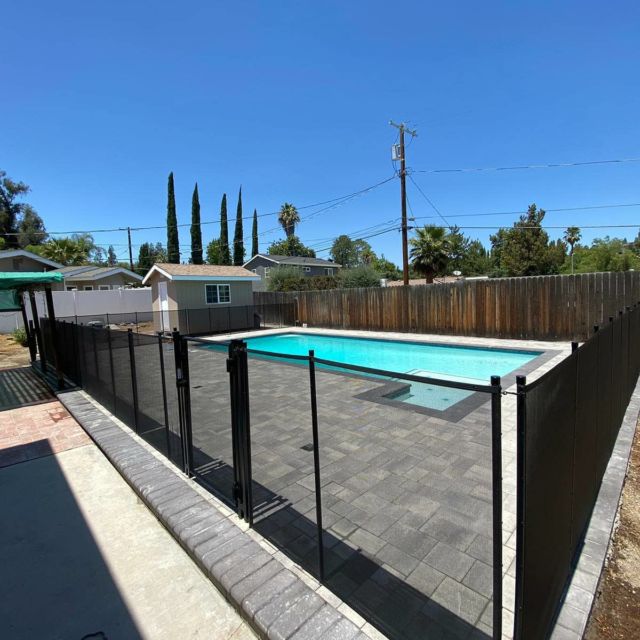
Mesh pool fencing is one of the most widely used options in Southern California, and for good reason. It satisfies every dimensional requirement under HSC §115923: it reaches the required 60-inch height, provides no footholds for climbing, maintains the correct ground clearance, and passes the 4-inch gap test. When installed correctly, mesh pool fence installation is fully compliant with California state law and local pool fence code requirements across all six Southern California counties.
Beyond compliance, mesh offers practical advantages. It’s see-through, so you have clear sightlines to the pool at all times. It’s modular and removable, meaning it adapts to your property and lifestyle without sacrificing safety.
Gate, Latch & Self-Closing Requirements
California law is explicit about pool gates. Under HSC §115923, any access gate through the enclosure must:
- Open away from the swimming pool, not toward it
- Be self-closing, return to a closed position without manual assistance
- Be self-latching, automatically latch when closed, without any user action required
The latch mechanism on self-closing, self-latching devices used as a standalone barrier must be placed no lower than 54 inches above the floor. Gates are the most common point of failure in pool barrier compliance. If your gate doesn’t close and latch on its own every time, your enclosure does not meet California pool fence law.
Removable Pool Fencing, Is It Legal in California?
Yes. Removable pool fence installation is explicitly recognized under HSC §115922(a)(2), provided the fencing meets the ASTM International F2286 standard and is used in conjunction with a compliant gate.
ASTM F2286 is a performance standard developed specifically for removable pool fencing. It covers tensile strength, mesh opening size, post stability, and gate hardware. Any removable fence system claiming to meet California pool fence laws should be able to demonstrate ASTM F2286 compliance, ask your installer for documentation.
Removable pool fencing is especially popular with Southern California families because it can be taken down when not needed and re-installed quickly. It provides full compliant protection when up, without being a permanent fixture on your property.
Pool Fence Laws by County in Southern California
All six Southern California counties enforce the California Swimming Pool Safety Act (HSC §115922–115929) as their baseline. However, each county’s building department may adopt local amendments through the California Building Code adoption process, and permit requirements vary. Pool Defence installs compliant mesh pool fencing across all six counties, see our full Southern California service area for coverage details.
Los Angeles County Pool Fence Laws
Los Angeles County enforces state pool fence requirements through the Department of Public Works, Building and Safety Division for unincorporated areas. Within city limits, enforcement falls to LADBS. Both follow HSC §115922 as the baseline. Pool enclosures must meet the 60-inch height minimum and all gate requirements. Permits are required for all new pool construction and major remodeling. Contact your local building department to confirm if any city-specific amendments apply to your address. Pool Defence provides mesh pool fence installation throughout Los Angeles County.
San Diego County Pool Fence Laws
San Diego County enforces swimming pool fence regulations through the Department of Planning & Development Services. The county follows California state law as its baseline, with pool fencing required as part of the final inspection process for any permitted pool. Homeowners in incorporated cities should check with their city’s building department for any local additions to the state standard. Pool Defence serves homeowners across San Diego County.
San Bernardino County Pool Fence Laws
San Bernardino County’s Land Use Services, Building and Safety Division oversees pool fence code compliance for unincorporated areas. The county enforces HSC §115922 and requires pool barrier compliance before issuing a certificate of occupancy. Given the size and diversity of San Bernardino County, homeowners should confirm whether their specific city or community has adopted local amendments. Pool Defence installs compliant fences for swimming pools throughout San Bernardino County.
Orange County Pool Fence Laws
Orange County enforces pool fencing laws through OC Public Works, Building and Safety for unincorporated areas. All 34 cities within Orange County are fully incorporated and each enforces their own building code, which must meet or exceed the state standard. Pool fence requirements California law sets the floor; your city may go higher. Contact your city’s building department to confirm local fence requirements for a pool in your area. Pool Defence covers the full Orange County service area.
Riverside County Pool Fence Laws
Riverside County’s Building and Safety Department oversees swimming pool fence regulations for unincorporated areas. The county follows California state law. Riverside County is one of the fastest-growing regions in Southern California, with pool ownership rising rapidly, and enforcement of pool barrier requirements at time of final inspection is standard practice. Incorporated cities such as Palm Springs, Temecula, and Murrieta each handle their own permitting and inspections. Pool Defence serves homeowners throughout Riverside County.
Ventura County Pool Fence Laws
Ventura County Public Works, Building and Safety enforces California pool fence law for unincorporated areas. The county follows HSC §115922 and requires an approved pool barrier before a final permit is issued. Cities such as Thousand Oaks, Oxnard, and Ventura have their own building departments that enforce the same state minimums, with possible local additions. Always confirm with your local jurisdiction. Pool Defence installs compliant mesh pool fencing across Ventura County.
Pool Permits & Inspections: What to Expect
Any time you install a new pool, remodel an existing pool, or make structural changes to your pool barrier in California, a building permit is required. The permit process typically involves:
- Plan check, your proposed pool design and barrier system are reviewed for compliance with HSC §115922–115923 and applicable California Building Code sections
- Construction inspections, a building inspector visits at key stages of construction
- Final inspection, before the permit is finalized, your pool barrier is physically inspected to confirm it meets all pool fence requirements California law mandates
Skipping the permit process doesn’t make the requirement go away; it creates liability exposure and can complicate a property sale.
Pool Fence Code Violations, Penalties & What to Expect
Failure to comply with California law regarding pool fences carries real consequences. Under HSC §115928, any person who violates the Swimming Pool Safety Act is subject to a civil penalty of up to $1,000 per violation. Beyond fines, non-compliance can:
- Result in a failed final inspection and a delayed certificate of occupancy
- Create significant liability in the event of a drowning or near-drowning incident
- Complicate the sale of your home, buyers and their agents increasingly check for pool permit compliance
How Mesh Pool Fencing Meets California Pool Fence Requirements
Mesh pool fencing is the most practical, compliant solution for most Southern California homeowners, and it’s the solution Pool Defence installs across our full Southern California service area.
Here’s how a properly installed mesh pool fence meets every requirement under California pool fence laws:
- Height: Pool Defence installs mesh panels to 60 inches (5 feet), meeting the state minimum under HSC §115923
- Ground clearance: Panels are installed with a maximum 2-inch ground clearance, as required
- Gap size: Mesh openings are well below the 4-inch sphere standard, compliant by design
- Climbability: Mesh provides no footholds or handhands, passing the no-climbable-surface requirement under HSC §115923(e)
- ASTM F2286: Pool Defence’s removable systems meet the ASTM International F2286 standard, satisfying HSC §115922(a)(2)
- Gates: All gates are self-closing and self-latching, opening away from the pool
Whether you need a permanent installation or removable pool fencing that can come down for adult events and go back up in minutes, mesh pool fence installation by Pool Defence covers you.
Get a Compliant Mesh Pool Fence Installed in Southern California
Pool Defence serves homeowners across Southern California. Every installation is fully compliant with California swimming pool fence law and carried out by a team that built this business on one belief, that every pool in Southern California should be a safe one.
Sources
- “Health and Safety Code Section 115922.” California Legislative Information, California State Legislature, amended 1 Jan. 2025, leginfo.legislature.ca.gov. Accessed 22 June 2026.
- “Health and Safety Code Section 115923.” California Legislative Information, California State Legislature, leginfo.legislature.ca.gov. Accessed 22 June 2026.
- “Health and Safety Code Section 115928.” California Legislative Information, California State Legislature, leginfo.legislature.ca.gov. Accessed 22 June 2026.
- “Plan Check & Permits.” Los Angeles Department of Building and Safety, City of Los Angeles, dbs.lacity.gov. Accessed 22 June 2026.
- “Building & Construction.” Planning & Development Services, County of San Diego, sandiegocounty.gov/pds. Accessed 22 June 2026.
- “Building and Safety.” Land Use Services, County of San Bernardino, sbcounty.gov. Accessed 22 June 2026.
- “Building and Safety.” OC Public Works, County of Orange, ocpublicworks.com. Accessed 22 June 2026.
- “Building and Safety Services.” Transportation and Land Management Agency, County of Riverside, rctlma.org/bss. Accessed 22 June 2026.
- “Building and Safety.” Public Works Agency, County of Ventura, vcpublicworks.org. Accessed 22 June 2026.