
Ventura County is the most compact county in Pool Defence’s Southern California service area, ten incorporated cities, a manageable stretch of coastline, and a county building department that covers more of the residential landscape than its counterparts in larger counties. That simplicity makes pool fence laws in Ventura County more navigable than in San Bernardino or Riverside, but there are local factors that make it genuinely distinct: a wildfire rebuild context that other counties don’t have in the same way, an Ojai Valley vacation property market with its own compliance questions, and a coastal strip where the California Coastal Commission adds a step for some homeowners.
This guide covers what pool fence requirements apply in Ventura County, how its ten-city structure works, and what homeowners in different parts of the county need to know before installing any barrier.
For the full statewide baseline, see our guide to California pool fence laws.
Ventura County’s Ten Cities and Its County Territory
Ventura County has ten incorporated cities: Ventura, Oxnard, Thousand Oaks, Simi Valley, Camarillo, Moorpark, Fillmore, Santa Paula, Ojai, and Port Hueneme. If your property is within one of these cities, your city’s building department issues your pool fence permit and conducts the inspection.
Everything outside these ten cities falls under the Ventura County Planning Division, which handles permits for unincorporated areas including Santa Rosa Valley, Oak Park, Somis, Camarillo Heights, and other communities that sit between or beyond city limits.
With only ten incorporated cities against a county of 1,845 square miles, the county planning division covers a meaningful share of Ventura County’s residential properties. If you are unsure which jurisdiction applies to your address, confirm with the county’s parcel lookup before contacting any building authority.
Who Needs a Pool Fence in Ventura County?
Under California Health & Safety Code §115922, any private single-family home with a swimming pool or spa must have at least one approved safety barrier in place before a final permit is issued. In Ventura County, this applies to:
- Any new pool construction requiring a building permit
- Any existing pool undergoing remodeling or alteration that triggers a new permit
- Any property where a pool safety barrier is being replaced or materially changed
There is no exemption by pool size, age, or property type. This includes rural properties on agricultural land, vacation homes in the Ojai Valley, and properties rebuilt after the Thomas or Woolsey fires.
Pool Fence Height Requirements in Ventura County
Pool fence requirements in California are set by Health and Safety Code §115923. Any enclosure used as a pool barrier must meet all of the following:
- Minimum height of 60 inches (5 feet) measured from the outside of the enclosure
- Maximum ground clearance of 2 inches: no gap larger than 2 inches between the bottom of the fence and the ground
- No gap or void allowing a 4-inch sphere to pass through; the standard used to prevent young children from squeezing through or becoming trapped
- No climbable surface: the outside of the fence must be free of protrusions, cavities, or features a child could use to climb over
These are the state minimums for pool fence standards. Individual cities and the county planning division may apply additional requirements. Always confirm with your building authority before purchasing or installing any barrier.
Approved Pool Barrier Types in Ventura County
California Health & Safety Code §115922 recognizes seven approved pool safety features. Every pool property in Ventura County must have at least one of the following:
- A barrier enclosure meeting the requirements of HSC §115923
- Removable mesh fencing meeting the ASTM International F2286 standard with a compliant gate
- A manually or power-operated safety pool cover with a verified label
- Exit alarms on all doors and windows providing direct access to the pool area
- A self-closing, self-latching device with a release mechanism no lower than 54 inches above the floor
- An operable pool alarm that detects entry into the water
- Any other means of protection providing equal or greater protection
An exit alarm and a self-latching device on the same door do not count as two qualifying features. Confirm your barrier configuration with the relevant building authority before scheduling a final inspection.
Why Mesh Pool Fencing Works Well for Ventura County Properties
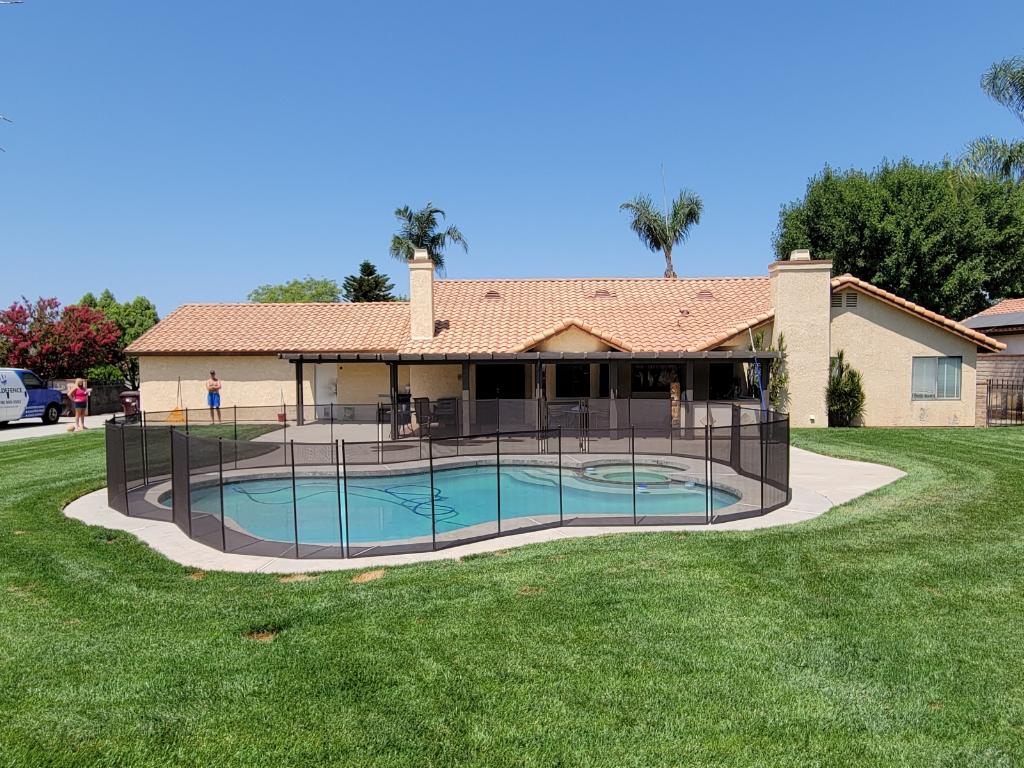
Our mesh pool fence meets every requirement under HSC §115923 and qualifies as an ASTM F2286 compliant removable barrier under HSC §115922(a)(2). It clears the 60-inch height minimum, passes the 4-inch gap test, provides no climbable surface, and paired with a self-closing, self-latching gate, functions as a fully standalone compliant barrier.
Ventura County’s mild coastal climate makes pools usable for most of the year. A removable pool fence gives families full flexibility — the barrier goes up when young children are present and comes down in minutes for adult use or outdoor entertaining. Pool Defence installs compliant fences for swimming pools across Ventura County and throughout our Southern California service area.
Gate and Latch Requirements in Ventura County
Under HSC §115923, every access gate through a pool enclosure must:
- Open away from the pool, not toward the water
- Be self-closing, returning to a fully closed position without manual assistance
- Be self-latching, automatically latching upon closing with no user action required
Where a self-closing, self-latching device is used as a standalone barrier, the release mechanism must be placed no lower than 54 inches above the floor per HSC §115922(a)(5).
Gates remain the most common point of failure at final pool fence inspections across Ventura County. A gate that requires a manual push to latch renders the entire enclosure non-compliant regardless of how well the fence itself was installed.
Removable Pool Fencing in Ventura County
Removable pool fencing is explicitly recognized under HSC §115922(a)(2) as a standalone compliant barrier, provided the fence meets the ASTM International F2286 performance standard and is paired with a compliant gate.
ASTM F2286 covers mesh opening size, tensile strength, post stability, and gate hardware performance. Ask any installer for written ASTM F2286 documentation before signing a contract. Compliance should be verifiable on paper, not just verbally claimed.
Mesh pool fencing is the most practical choice for Ventura County families who want a barrier that fits around their daily life rather than defining it. When it is installed, it fully satisfies pool fence laws under California state law.
Wildfire Rebuilds: A Ventura County-Specific Compliance Context
No other county in Pool Defence’s service area carries the wildfire rebuild context that Ventura County does. The 2017 Thomas Fire burned more than 280,000 acres across Ventura and Santa Barbara counties. The 2018 Woolsey Fire tore through communities in the eastern part of the county, including areas of Thousand Oaks. Together, they destroyed hundreds of homes and prompted significant residential rebuilding activity in the years that followed.
If your home in Ventura County was rebuilt after a wildfire event, the rebuild required a building permit. Any pool on that property, either existing before the fire or constructed during the rebuild, was subject to current pool fence requirements that California law mandates under the permit. That means a pool that may have predated modern barrier requirements at the original structure now needs to meet current pool fence standards under HSC §115922 and §115923.
If you purchased a rebuilt property in a fire-affected area of Ventura County and are unsure whether the pool barrier was permitted and inspected under the rebuild, confirm with your city’s building department or the county planning division before assuming compliance. This is a due diligence step that matters significantly in eastern Ventura County communities and the hillside areas above the coast.
Coastal Properties: The Coastal Commission Layer
Ventura County’s coastline runs from the LA County border near Point Mugu north through Port Hueneme, Oxnard, and Ventura. For properties within the California Coastal Zone, pool construction or significant remodeling may require a Coastal Development Permit from the California Coastal Commission in addition to a local building permit.
The pool fence requirements themselves are not altered by Coastal Zone designation, but the permit process is longer when the Coastal Commission is involved. The Commission’s permit lookup tool can confirm whether your property falls within the Coastal Zone before you begin any work. Factor Coastal Commission review into your timeline; it adds weeks beyond the standard city permit process.
Ojai Valley Properties: Vacation Homes and Retreat Properties
Ojai has built a distinct identity as one of Southern California’s premier wellness, arts, and retreat destinations. The valley draws visitors seeking a slower pace and has developed a growing market of boutique vacation rentals and second homes alongside its permanent residential community.
For Ojai homeowners with pools, the compliance picture is similar to other vacation property markets in the region. Properties used as short-term rentals carry the same California pool fence law obligations as primary residences; there is no exemption for occasional or seasonal rental use. A pool at a vacation rental without a compliant barrier creates both a permit violation and a significant liability exposure given the commercial nature of hosting paying guests.
Pool permits in Ojai go through the City of Ojai Building Division. For properties in the surrounding unincorporated Ojai Valley area, the Ventura County Planning Division is the permit authority.
How the Permit Process Works in Ventura County
Whether you are in one of the ten incorporated cities or in unincorporated county territory, the general permit sequence is consistent:
- Application: Submit your pool barrier permit application to the relevant authority. City residents apply through their city’s building department. Unincorporated area residents apply through the Ventura County Planning Division.
- Plan check: Your barrier configuration is reviewed against HSC §115922 and §115923 and any applicable local amendments.
- Permit issued: Once approved, installation can begin.
- Inspections: A building inspector visits at key construction stages.
- Final sign-off: The completed barrier is physically inspected before the permit closes.
Ventura County’s ten-city structure makes this one of the more straightforward permit landscapes in Southern California. Timelines vary by city, but the county’s relatively modest permit volume outside of Oxnard and Thousand Oaks means approvals can move faster than in larger jurisdictions.
Pool Fence Rules by City in Ventura County
All ten incorporated cities and unincorporated county territory must meet California pool fence law minimums under HSC §115922 and §115923. Key building authorities:
- City of Ventura: Pool permits through the City of San Buenaventura Building and Safety Division.
- Oxnard: Pool permits through the City of Oxnard Development Services Department.
- Thousand Oaks: City of Thousand Oaks Building and Safety Division.
- Simi Valley: City of Simi Valley Building and Safety Division.
- Camarillo: City of Camarillo Development Services.
- Moorpark: City of Moorpark Community Development Department.
- Fillmore: City of Fillmore Building and Safety.
- Santa Paula: City of Santa Paula Building Division.
- Ojai: City of Ojai Building and Safety.
- Port Hueneme: City of Port Hueneme Building Division.
- Unincorporated Ventura County (Santa Rosa Valley, Oak Park, Somis, Camarillo Heights, unincorporated Ojai Valley, and others): Ventura County Planning Division.
Pool Fence Inspections: What Ventura County Inspectors Look For
A city or county building inspector physically assesses your barrier against fence requirements for a pool under HSC §115923. Standard inspection points include:
- Height: minimum 60 inches from the outside at all points, including corners and gate frames
- Ground clearance: no gap exceeding 2 inches anywhere along the fence line, a notable concern on hillside properties in fire-rebuild areas where grading may have changed the original terrain
- Gap size: no opening allows a 4-inch sphere to pass through
- Gate self-close and self-latch: tested from multiple open positions; must close and latch without manual assistance every time
- Gate direction: must open away from the pool
- Climbability: outside surface assessed for horizontal rails, footholds, or other climbing aids
On hillside and post-fire rebuild properties, inspectors pay particular attention to ground clearance at points where the fence line crosses uneven or re-graded terrain.
Why Pool Fence Compliance Matters in Ventura County
Under HSC §115928, violations of the Swimming Pool Safety Act carry civil penalties of up to $1,000 per violation. Beyond fines, non-compliance creates significant liability exposure in the event of a drowning or near-drowning incident.
For homeowners in Ventura County’s real estate market, pool permit history is increasingly part of buyer due diligence. For fire-rebuild properties in particular, verifying that every aspect of the rebuild, including any pool barrier, was permitted and signed off correctly is a standard escrow step. Getting compliant before you list, before you rent, or before your rebuild permit closes protects both your family and your investment.
Get a Compliant Pool Fence Installed in Ventura County
Pool Defence installs fully compliant mesh pool fencing across Ventura County, from the coast through the Ojai Valley and the communities along the 101 corridor. Every installation meets the full range of pool fence standards enforced across Ventura County’s ten cities and unincorporated areas. View our full service area to confirm we cover your address.
Sources
- “Health and Safety Code Section 115920.” California Legislative Information, California State Legislature, leginfo.legislature.ca.gov. Accessed 16 Oct. 2026.
- “Health and Safety Code Section 115922.” California Legislative Information, California State Legislature, amended 1 Jan. 2025, leginfo.legislature.ca.gov. Accessed 16 Oct. 2026.
- “Health and Safety Code Section 115923.” California Legislative Information, California State Legislature, leginfo.legislature.ca.gov. Accessed 16 Oct. 2026.
- “Health and Safety Code Section 115928.” California Legislative Information, California State Legislature, leginfo.legislature.ca.gov. Accessed 16 Oct. 2026.
- “Planning Division.” County of Ventura, planning.ventura.org. Accessed 16 Oct. 2026.
- “Coastal Development Permits.” California Coastal Commission, www.coastal.ca.gov. Accessed 16 Oct. 2026.
- “Building and Safety Division.” City of San Buenaventura, www.cityofventura.ca.gov. Accessed 16 Oct. 2026.
- “Development Services Department.” City of Oxnard, www.oxnard.org. Accessed 16 Oct. 2026.
- “Building and Safety Division.” City of Thousand Oaks, www.toaks.org. Accessed 16 Oct. 2026.
- “Building and Safety Division.” City of Simi Valley, www.simivalley.org. Accessed 16 Oct. 2026.
- “Development Services.” City of Camarillo, www.ci.camarillo.ca.us. Accessed 16 Oct. 2026.
- “Building Safety.” City of Moorpark, www.moorparkca.gov. Accessed 16 Oct. 2026.
- “Community Development.” City of Fillmore, www.fillmoreca.gov. Accessed 16 Oct. 2026.
- “Building Division.” City of Santa Paula, www.santapaulaca.gov. Accessed 16 Oct. 2026.
- “Building and Safety.” City of Ojai, www.ojaica.gov. Accessed 16 Oct. 2026.
- “Building Division.” City of Port Hueneme, www.ci.port-hueneme.ca.us. Accessed 16 Oct. 2026.