
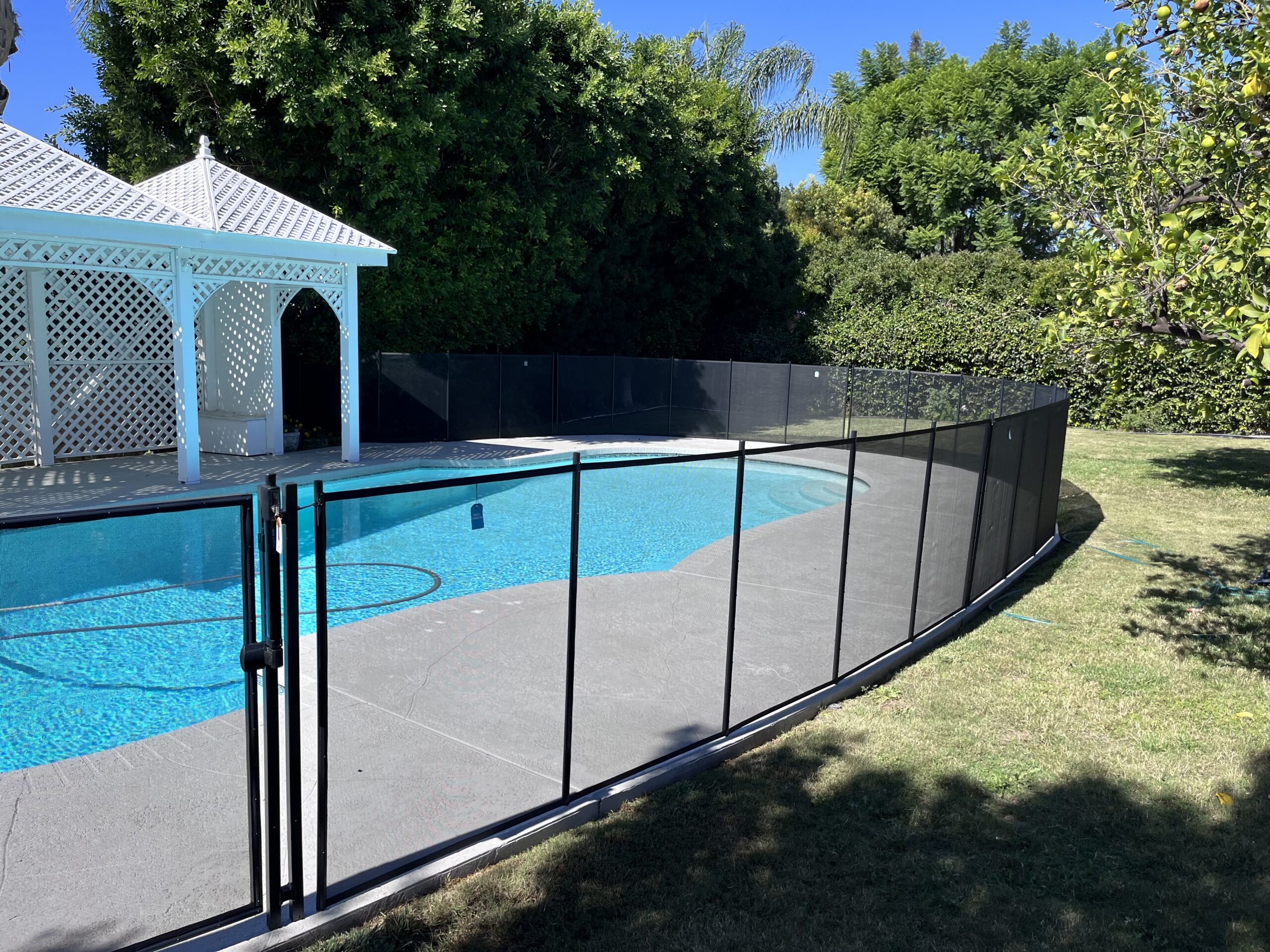
Orange County is different from every other Southern California county when it comes to pool fence laws, and most homeowners don’t realize it until they’re in the middle of a permit process. Unlike Los Angeles or San Bernardino, virtually every residential property in Orange County sits within an incorporated city. That means there is no meaningful “county” layer for most homeowners to worry about. Your city is your authority, and knowing which city’s building department governs your address is the first thing you need to get right.
This guide breaks down pool fence requirements in Orange County, what the state law actually says, how your city enforces it, and why getting this right matters more in Orange County’s real estate market than almost anywhere else in California.
For the full statewide baseline, see our guide to California pool fence laws.
Why Orange County Pool Fence Compliance Works Differently
In Los Angeles County, unincorporated communities are common and the county’s Department of Public Works handles a significant share of building permits. Orange County is almost the opposite. With 34 fully incorporated cities covering the vast majority of its 205 square miles of unincorporated land, nearly every residential pool in Orange County falls under a city’s jurisdiction.
What this means in practice: pool fence orange county compliance is a city-by-city conversation. The OC Public Works Development Services division handles permits for the small pockets of unincorporated land that remain, but if you live in Anaheim, Irvine, Newport Beach, or any of the other 31 cities, your city’s building department is who issues your permit, conducts your inspection, and signs off on your barrier.
The baseline every city must meet is the same: California Health & Safety Code §115922–115929, the Swimming Pool Safety Act. What differs is the permit process, fees, inspection culture, and any local amendments each city has layered on top.
Who Needs a Pool Fence in Orange County?
Under California Health & Safety Code §115922, any private single-family home with a swimming pool or spa must have at least one approved safety barrier in place before a final permit is issued. For orange county pools, this requirement applies to:
- Any new pool construction requiring a building permit
- Any existing pool undergoing remodeling or alteration that triggers a new permit
- Any property where a pool safety barrier is being replaced or materially changed
There is no exemption by pool size, age of construction, or property type. If you recently purchased a home in Orange County with an existing pool and no visible barrier, it is worth confirming with your city’s building department whether the original installation was permitted and signed off correctly, particularly before listing the property for sale.
Pool Fence Height Requirements in Orange County
The fence height requirement for swimming pool barriers in California is set by Health and Safety Code §115923. Any enclosure used as a pool barrier must meet all of the following:
- Minimum height of 60 inches (5 feet) measured from the outside of the enclosure
- Maximum ground clearance of 2 inches: no gap larger than 2 inches between the bottom of the fence and the ground
- No gap or void allowing a 4-inch sphere to pass through, the standard used to prevent young children from squeezing through or becoming trapped
- No climbable surface: the outside of the fence must be free of protrusions, cavities, or features a child could use to climb over
These are the state minimums for fence height requirements for pools. Some Orange County cities have adopted local amendments that go further, particularly in cities with active HOA communities where additional standards may apply on top of city code. Always verify with your specific city before installation.
Approved Pool Barrier Types in Orange County
California Health & Safety Code §115922 recognizes seven approved pool safety features. A property in Orange County must have at least one of the following to satisfy pool fence requirements california law mandates:
- A barrier enclosure meeting the requirements of HSC §115923
- Removable mesh fencing meeting the ASTM International F2286 standard with a compliant gate
- A manually or power-operated safety pool cover with a verified label
- Exit alarms on all doors and windows providing direct access to the pool area
- A self-closing, self-latching device with a release mechanism no lower than 54 inches above the floor
- An operable pool alarm that detects entry into the water
- Any other means of protection providing equal or greater protection
Certain combinations are explicitly excluded. An exit alarm and a self-latching device on the same door do not count as two qualifying features. Confirm your barrier configuration with your city’s building department or inspector before scheduling a final inspection.
Why Mesh Pool Fencing Is the Preferred Solution Across Orange County
Our mesh pool fence satisfies every dimensional and structural requirement under HSC §115923 and qualifies as an ASTM F2286 compliant removable barrier under HSC §115922(a)(2). It meets the 60-inch height minimum, passes the 4-inch gap test, provides no climbable surface, and with a self-closing, self-latching gate, functions as a fully standalone compliant barrier.
Mesh pool fencing is the most widely installed removable pool fence across Orange County. In master-planned communities like Irvine and Mission Viejo where aesthetics matter and HOAs have design standards, mesh is often the only barrier type that satisfies both code and community requirements simultaneously: it’s transparent, low-profile, and removable when not needed. Pool Defence installs compliant fences for swimming pools throughout Orange County and across our full Southern California service area.
Gate and Latch Requirements in Orange County
Under HSC §115923, every access gate through a pool enclosure must:
- Open away from the pool, not toward the water
- Be self-closing, returning to a fully closed position without any manual assistance
- Be self-latching, automatically latching upon closing with no user action required
Where a self-closing, self-latching device is used as a standalone barrier rather than within a full enclosure, the release mechanism must be placed no lower than 54 inches above the floor per HSC §115922(a)(5).
Across Orange County cities, gates are the most common point of failure during final pool fence inspections. A gate that swings freely or requires a manual push to latch means your enclosure is non-compliant, regardless of how well the fence itself performs. This is especially important in coastal cities like Newport Beach and Laguna Beach, where humid salt air can affect gate hardware over time and cause latching mechanisms to degrade.
Removable Pool Fencing in Orange County
Removable pool fencing is explicitly recognized as a compliant barrier option under HSC §115922(a)(2), provided the fence meets the ASTM International F2286 performance standard and is paired with a compliant gate.
This standard covers mesh opening size, tensile strength, post stability, and gate hardware performance. Ask any installer to provide written ASTM F2286 documentation before you sign a contract. Compliance should be verifiable on paper, not just claimed verbally.
Removable pool fencing is the dominant choice for Orange County families, and for good reason. The county’s outdoor lifestyle means pools are in use throughout the year. Being able to remove the fence for adult gatherings and reinstate it in 10 to 15 minutes is a practical advantage that permanent solutions simply cannot match. When it is up, it fully satisfies california pool fence law.
The HOA Layer: What Orange County Homeowners Need to Know
This is where Orange County pool fence compliance gets genuinely more complex than in most California counties. A significant proportion of Orange County’s residential communities are governed by Homeowners Associations, particularly in master-planned cities like Irvine, Mission Viejo, Laguna Niguel, Rancho Santa Margarita, and Aliso Viejo.
HOAs operate on top of city and state rules, not instead of them. Your barrier must satisfy both your HOA’s CC&Rs and California state law simultaneously. In practice this means:
- HOA approval may be required before installation: even if your city building permit is in hand, some HOAs require a separate architectural review approval before any pool barrier can go up
- HOA aesthetic requirements may restrict materials: some HOAs prohibit certain colors, post finishes, or gate styles that would otherwise be code-compliant
- HOA rules cannot override state safety law: if state law requires a barrier and your HOA prohibits it, state law takes precedence, though the HOA may still have input on the type and appearance of that barrier
Before installing any pool fence orange county barrier, check your CC&Rs and contact your HOA’s architectural committee. Pool Defence is experienced working within OC’s HOA landscape and can advise on barrier configurations that satisfy both code and community standards.
How the Permit Process Works in Orange County
Because Orange County is almost entirely incorporated, the permit process runs through individual city building departments. While each city has its own portal, fees, and timeline, the general sequence is consistent:
- Application: Submit a pool barrier permit application to your city’s building department. Most Orange County cities now offer online submission portals. Check your city’s website for current options.
- Plan check: Your barrier configuration is reviewed against pool fence standards under HSC §115922 and §115923 and any applicable local amendments.
- Permit issued: Once approved, work can begin.
- Inspections: Your city’s building inspector visits at key construction stages.
- Final sign-off: Your completed barrier is physically inspected before the permit is closed.
Timeline varies significantly by city. Some Orange County cities have same-week permit approvals for straightforward residential pool barriers; others have longer plan check queues. Factor this into your project schedule.
Pool Fence Rules by City in Orange County
All 34 cities must meet California pool fence law minimums, but each operates independently. Here are the building departments for the county’s most populated cities:
- Anaheim: Pool permits and inspections handled by the City of Anaheim Planning and Building Department. As the county’s largest city by population, Anaheim processes a high volume of residential pool permits annually.
- Irvine: The City of Irvine Community Development Department enforces pool fence requirements across one of the nation’s largest master-planned cities. Irvine’s high proportion of HOA communities means many homeowners face a dual compliance process: city code and HOA approval.
- Santa Ana: Pool barrier compliance enforced by Santa Ana’s Building Division. Permits required for all new pool construction and barrier replacements.
- Huntington Beach: The City of Huntington Beach Community Development Department handles pool fence Orange County compliance for one of the county’s most pool-dense coastal cities.
- Newport Beach: The City of Newport Beach Building Division enforces pool barrier requirements. Newport Beach’s premium property values mean pool compliance is closely scrutinized at the point of sale.
- Costa Mesa: Pool barrier permits handled by the City of Costa Mesa Building and Safety Division.
- Laguna Beach: The city’s terrain and premium coastal properties mean inspectors pay close attention to ground clearance and height compliance at uneven terrain points, a common failure area in hillside properties.
If your city is not listed above, contact your city’s building or community development department directly to confirm current pool fence requirements and any local amendments.
Pool Fence Inspections: What Orange County Inspectors Look For
During a final pool fence inspection in Orange County, a city building inspector physically assesses your barrier against the fence requirements for a pool under HSC §115923. Standard inspection points include:
- Height: minimum 60 inches from the outside at all points, including corners and gate frames
- Ground clearance: no gap exceeding 2 inches anywhere along the fence line, including over roots, slopes, or uneven paving, a common failure point in Laguna Beach and Newport Beach hillside properties
- Gap size: no opening allows a 4-inch sphere to pass through
- Gate self-close and self-latch: tested from multiple open positions; must close and latch without manual assistance every time
- Gate direction: must open away from the pool
- Climbability: outside surface assessed for horizontal rails, footholds, or other climbing aids
In coastal Orange County cities, inspectors also pay attention to hardware corrosion, particularly on gate latching mechanisms. Salt air accelerates wear on inferior hardware. It’s another reason Pool Defence uses 304 stainless steel components throughout.
Why Pool Fence Compliance Matters at Point of Sale in Orange County
Orange County has one of the most active and high-value residential real estate markets in California. Pool compliance is not just a safety issue here. It is a transaction issue. Buyers, buyer’s agents, and title companies in Orange County increasingly request pool permit histories as part of due diligence. An unpermitted pool or a barrier that was never signed off can delay or kill a sale.
Under HSC §115928, violations of the Swimming Pool Safety Act carry civil penalties of up to $1,000 per violation. Beyond fines, non-compliance can mean a failed final inspection, stop-work orders on related construction, and significant liability exposure in the event of a drowning or near-drowning incident.
Getting compliant before you list, or before you begin a pool remodel, protects both your family and your investment.
Get a Compliant Pool Fence Installed in Orange County
Pool Defence installs fully compliant mesh pool fencing across Orange County from Anaheim and Irvine to Newport Beach, Huntington Beach, Laguna Beach, and everywhere in between. Every installation meets the full range of pool fence standards enforced across Orange County’s 34 cities, and we are experienced navigating HOA requirements alongside city code. View our full service area to confirm we cover your address.
Sources
- “Health and Safety Code Section 115920.” California Legislative Information, California State Legislature, leginfo.legislature.ca.gov. Accessed 14 Aug. 2026.
- “Health and Safety Code Section 115922.” California Legislative Information, California State Legislature, amended 1 Jan. 2025, leginfo.legislature.ca.gov. Accessed 14 Aug. 2026.
- “Health and Safety Code Section 115923.” California Legislative Information, California State Legislature, leginfo.legislature.ca.gov. Accessed 14 Aug. 2026.
- “Health and Safety Code Section 115928.” California Legislative Information, California State Legislature, leginfo.legislature.ca.gov. Accessed 14 Aug. 2026.
- “OC Public Works.” County of Orange, pw.oc.gov. Accessed 14 Aug. 2026.
- “Planning and Building Department.” City of Anaheim, www.anaheim.net. Accessed 14 Aug. 2026.
- “Community Development.” City of Irvine, cityofirvine.gov. Accessed 14 Aug. 2026.
- “Building Division.” City of Santa Ana, santa-ana.org. Accessed 14 Aug. 2026.
- “Community Development — Building.” City of Huntington Beach, www.huntingtonbeachca.gov. Accessed 14 Aug. 2026.
- “Building Division.” City of Newport Beach, www.newportbeachca.gov. Accessed 14 Aug. 2026.
- “Building and Safety Division.” City of Costa Mesa, www.costamesaca.gov. Accessed 14 Aug. 2026.