
Riverside County covers more ground than any other county in Southern California, and its pool landscape reflects that scale. Two completely different pool cultures exist within its borders: the Inland Empire, where cities like Riverside, Corona, Temecula, and Moreno Valley have dense residential neighborhoods and standard suburban pools, and the Coachella Valley, where Palm Springs, Palm Desert, Rancho Mirage, and Indian Wells are home to some of the highest concentrations of resort properties, second homes, and short-term rentals in California.
Pool fence laws apply uniformly across both regions under California state law, but how they play out in practice depends heavily on which part of the county you are in, whether your property is in an incorporated city or unincorporated county territory, and whether your pool is at a primary residence, a second home, or a vacation rental.
This guide covers what pool fence requirements apply in Riverside County, how jurisdiction works across the county’s 26 cities and large unincorporated areas, and what Coachella Valley property owners need to know that most compliance guides overlook.
For the full statewide baseline, see our guide to California pool fence laws.
Riverside County’s Two Distinct Pool Environments
Before getting into permit specifics, it helps to understand that pool fence requirements in Riverside County are enforced across two very different property contexts:
The Inland Empire (Riverside, Corona, Moreno Valley, Temecula, Murrieta, Menifee, Hemet): Primarily year-round residential properties with standard suburban pools. These are typically primary residences where the permit process follows a predictable city building department track.
The Coachella Valley (Palm Springs, Cathedral City, Rancho Mirage, Palm Desert, Indian Wells, La Quinta, Indio, Desert Hot Springs, Coachella): A mix of primary residences, luxury second homes, resort-style properties, and one of California’s most active short-term rental markets. Pools here face a different set of compliance pressures, particularly around seasonal occupancy and rental use.
This geographic divide is the defining context for pool compliance in Riverside County.
Incorporated City or Unincorporated County: Which Applies to You?
Like San Diego County, Riverside County has both incorporated cities and a large unincorporated territory. If you live within one of the county’s 26 cities, your city’s building department handles pool fence permits. If you live in unincorporated Riverside County, the County of Riverside Planning Department is your permit authority.
Unincorporated Riverside County covers significant residential areas, particularly in the eastern desert communities and rural areas between incorporated cities. If you are unsure which jurisdiction applies to your address, use the county’s parcel search tool to confirm before contacting any building department.
Getting this right at the start avoids submitting an application to the wrong authority, which restarts the timeline entirely.
Who Needs a Pool Fence in Riverside County?
Under California Health & Safety Code §115922, any private single-family home with a swimming pool or spa must have at least one approved safety barrier in place before a final permit is issued. In Riverside County, this applies to:
- Any new pool construction requiring a building permit
- Any existing pool undergoing remodeling or alteration that triggers a new permit
- Any property where a pool safety barrier is being replaced or materially changed
This applies equally to primary residences, second homes, and short-term rental properties. A seasonal property that sits empty for months of the year is not exempt from california pool fence law simply because it is unoccupied for part of the year.
Pool Fence Height Requirements in Riverside County
Pool fence requirements in California are set by Health and Safety Code §115923. Any enclosure used as a pool barrier must meet all of the following:
- Minimum height of 60 inches (5 feet) measured from the outside of the enclosure
- Maximum ground clearance of 2 inches: no gap larger than 2 inches between the bottom of the fence and the ground
- No gap or void allowing a 4-inch sphere to pass through, the standard used to prevent young children from squeezing through or becoming trapped
- No climbable surface: the outside of the fence must be free of protrusions, cavities, or features a child could use to climb over
These are the state minimums for pool fence standards. Individual cities may apply additional requirements. Always confirm with your specific building authority before purchasing or installing any barrier.
Approved Pool Barrier Types in Riverside County
California Health & Safety Code §115922 recognizes seven approved pool safety features. Every pool property in Riverside County must have at least one of the following:
- A barrier enclosure meeting the requirements of HSC §115923
- Removable mesh fencing meeting the ASTM International F2286 standard with a compliant gate
- A manually or power-operated safety pool cover with a verified label
- Exit alarms on all doors and windows providing direct access to the pool area
- A self-closing, self-latching device with a release mechanism no lower than 54 inches above the floor
- An operable pool alarm that detects entry into the water
- Any other means of protection providing equal or greater protection
An exit alarm and a self-latching device on the same door do not count as two qualifying features. Confirm your barrier configuration with the relevant building authority before scheduling a final inspection.
Why Mesh Pool Fencing Fits Riverside County’s Pool Culture
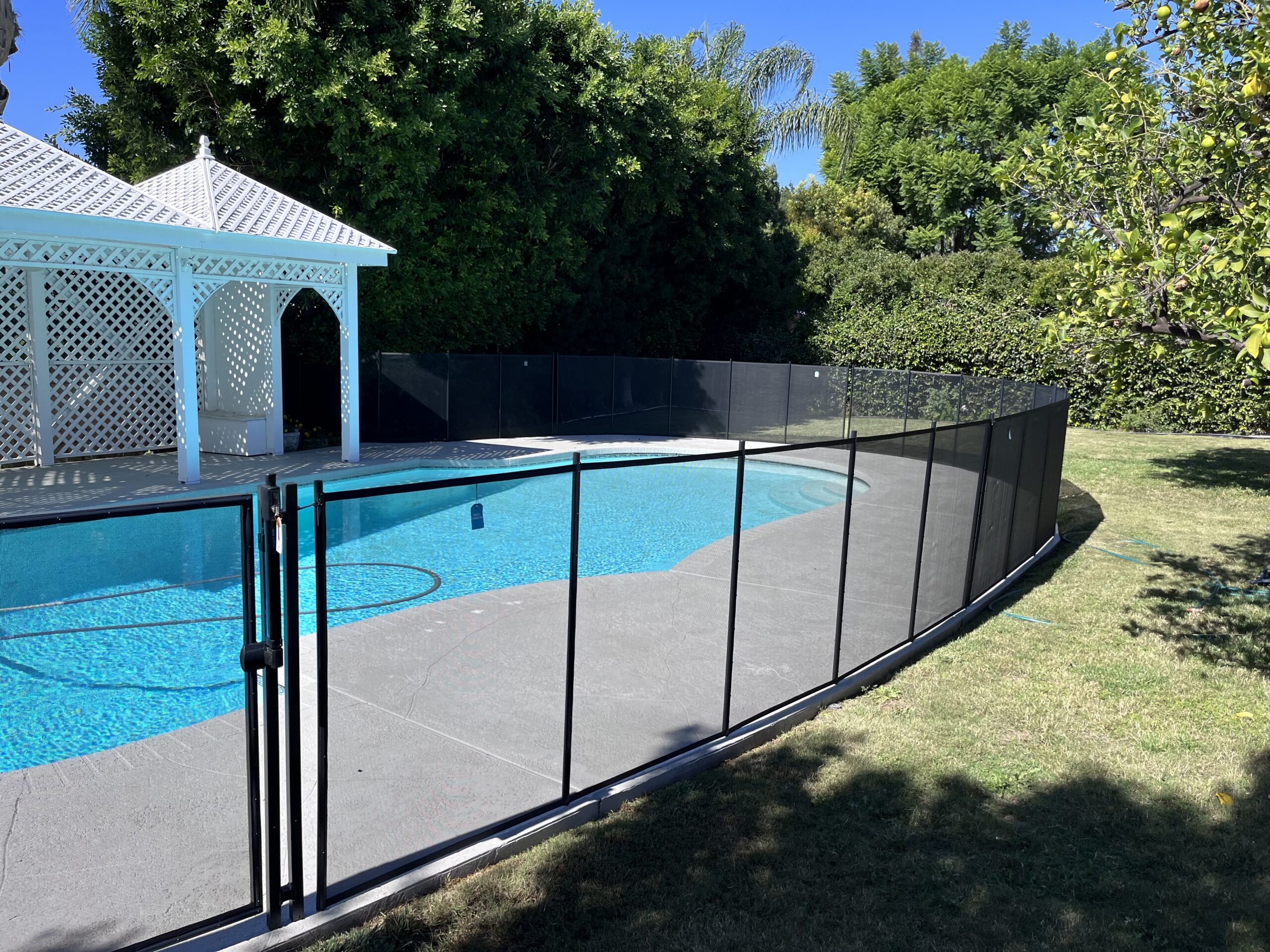
Our mesh pool fence meets every requirement under HSC §115923 and qualifies as an ASTM F2286 compliant removable barrier under HSC §115922(a)(2). It clears the 60-inch height minimum, passes the 4-inch gap test, provides no climbable surface, and paired with a self-closing, self-latching gate, functions as a fully standalone compliant barrier.
In the Coachella Valley, where pools are often the centerpiece of a property’s rental appeal or entertainment value, removable pool fencing is the obvious choice. A mesh pool fence goes up for families with young children and comes down in under 15 minutes for adult events or open-house showings. It satisfies pool fence requirements california law mandates without permanently altering the aesthetic of a high-value outdoor space. Pool Defence installs compliant fences for swimming pools across Riverside County and throughout our Southern California service area.
Gate and Latch Requirements in Riverside County
Under HSC §115923, every access gate through a pool enclosure must:
- Open away from the pool, not toward the water
- Be self-closing, returning to a fully closed position without manual assistance
- Be self-latching, automatically latching upon closing with no user action required
Where a self-closing, self-latching device is used as a standalone barrier, the release mechanism must be placed no lower than 54 inches above the floor per HSC §115922(a)(5).
In the Coachella Valley’s extreme summer heat, gate hardware expands and contracts significantly with temperature swings. Inspectors in desert cities pay attention to whether latching mechanisms continue to function reliably across those temperature ranges. Inferior hardware that latches fine in mild weather can fail in 110-degree summer conditions. This is a practical consideration unique to Riverside County’s desert communities.
Removable Pool Fencing in Riverside County
Removable pool fencing is explicitly recognized under HSC §115922(a)(2) as a standalone compliant barrier, provided the fence meets the ASTM International F2286 performance standard and is paired with a compliant gate.
Ask any installer to provide written ASTM F2286 documentation before signing a contract. Compliance should be verifiable on paper, not just verbally claimed.
Removable pool fencing is particularly well-suited to the Coachella Valley’s seasonal rhythm. Desert pool season peaks in winter and spring, when snowbird residents arrive and short-term rental bookings are highest. A removable barrier can go up when a family is in residence and be stored when the property is between guests or sitting empty over summer. When it is installed, it fully satisfies pool fence laws under California state law.
Short-Term Rentals and Pool Fence Compliance in the Coachella Valley
This is the section that most compliance guides skip entirely, and it matters significantly in Riverside County.
Palm Springs is one of California’s most short-term rental-active cities. Palm Desert, La Quinta, Rancho Mirage, and Cathedral City all have significant STR markets as well. If your property is registered as a short-term rental and it has a pool, pool barrier compliance is not just a building code issue. It is a licensing and liability issue that can affect your rental permit directly.
The City of Palm Springs operates one of California’s most detailed short-term rental licensing programs. Pool safety compliance is part of the STR inspection process. A non-compliant or unpermitted pool barrier can be grounds for STR permit suspension or non-renewal.
Beyond Palm Springs, if you operate a vacation rental with a pool anywhere in Riverside County and a child is injured due to a non-compliant or absent barrier, the liability exposure is compounded by the commercial nature of the activity. Getting and maintaining pool fence standards compliance is not optional for STR operators with pools, regardless of whether a city specifically calls it out in its STR ordinance.
Seasonal Properties: What Second Homeowners Need to Know
The Coachella Valley has a large second-home population that occupies properties primarily in the fall, winter, and spring months, leaving them vacant through the summer. California pool fence law does not distinguish between occupied and vacant properties. A pool at a vacant seasonal home is still subject to the same barrier requirements as a pool at a year-round primary residence.
If you own a second home in Palm Springs, Rancho Mirage, Indian Wells, or anywhere else in the Coachella Valley with a pool that sits unattended for months at a time, confirm the barrier is fully compliant before you leave for the season. A removable pool fence left in place during vacancy periods provides both compliance and an additional layer of deterrence against unauthorized pool access.
How the Permit Process Works in Riverside County
The general permit sequence applies whether you are in an incorporated city or unincorporated county territory:
- Application: Submit your pool barrier permit application to the relevant authority. City residents apply through their city’s building department portal. Unincorporated area residents apply through the County of Riverside Planning Department.
- Plan check: Your barrier configuration is reviewed against HSC §115922 and §115923 and any applicable local amendments.
- Permit issued: Once approved, installation can begin.
- Inspections: A building inspector visits at key construction stages.
- Final sign-off: The completed barrier is physically inspected before the permit closes.
Inland Empire cities like Riverside and Corona process high volumes of residential building permits and timelines can vary by season. Coachella Valley cities tend to have lower permit volumes outside peak season. Confirm current timelines with your building authority before scheduling work.
Pool Fence Rules by City in Riverside County
Key building authorities across Riverside County:
- City of Riverside: Pool permits through the City of Riverside Development Services.
- Corona: City of Corona Building and Safety Division.
- Temecula: City of Temecula Building and Safety.
- Moreno Valley: City of Moreno Valley Building and Safety.
- Murrieta: City of Murrieta Building Division.
- Palm Springs: Pool permits through the City of Palm Springs Building and Safety Division. STR operators should also confirm pool compliance requirements with the city’s Short-Term Rental Program.
- Palm Desert: City of Palm Desert Development Services.
- Rancho Mirage: City of Rancho Mirage Building Department.
- La Quinta: City of La Quinta Building Division.
- Unincorporated Riverside County: County of Riverside Planning Department.
If your city is not listed, contact your city’s building or community development department directly to confirm current pool fence requirements and any local amendments.
Pool Fence Inspections: What Riverside County Inspectors Look For
A city or county building inspector physically assesses your barrier against fence requirements for a pool under HSC §115923. Standard inspection points include:
- Height: minimum 60 inches from the outside at all points, including corners and gate frames
- Ground clearance: no gap exceeding 2 inches anywhere along the fence line, a common failure point on properties with sandy desert soil or landscaping that shifts over time
- Gap size: no opening allows a 4-inch sphere to pass through
- Gate self-close and self-latch: tested from multiple open positions; must close and latch without manual assistance every time
- Gate direction: must open away from the pool
- Climbability: outside surface assessed for horizontal rails, footholds, or other climbing aids
In Coachella Valley cities, inspectors also pay attention to whether gate hardware shows signs of heat-related wear, as extreme temperatures can affect the long-term performance of latching mechanisms.
Why Pool Fence Compliance Matters in Riverside County
Under HSC §115928, violations of the Swimming Pool Safety Act carry civil penalties of up to $1,000 per violation. Beyond fines, a non-compliant barrier creates significant liability exposure in the event of a drowning or near-drowning incident at any property, and that exposure is compounded for vacation rental operators whose commercial activity makes the property a business rather than a personal residence.
For owners selling Inland Empire properties, pool permit compliance is increasingly scrutinized during escrow. For Coachella Valley owners with STR licenses, it is an ongoing operational requirement. In both cases, getting compliant before any permit, listing, or rental activity begins is the right starting point.
Get a Compliant Pool Fence Installed in Riverside County
Pool Defence installs fully compliant mesh pool fencing across Riverside County, from the Inland Empire to Palm Springs and the Coachella Valley. Every installation meets the full range of pool fence standards enforced across Riverside County’s 26 cities and unincorporated areas. View our full service area to confirm we cover your address.
Sources
- “Health and Safety Code Section 115920.” California Legislative Information, California State Legislature, leginfo.legislature.ca.gov. Accessed 18 Sep. 2026.
- “Health and Safety Code Section 115922.” California Legislative Information, California State Legislature, amended 1 Jan. 2025, leginfo.legislature.ca.gov. Accessed 18 Sep. 2026.
- “Health and Safety Code Section 115923.” California Legislative Information, California State Legislature, leginfo.legislature.ca.gov. Accessed 18 Sep. 2026.
- “Health and Safety Code Section 115928.” California Legislative Information, California State Legislature, leginfo.legislature.ca.gov. Accessed 18 Sep. 2026.
- “Planning Department.” County of Riverside, planning.rctlma.org. Accessed 18 Sep. 2026.
- “Short-Term Rental Program.” City of Palm Springs, www.palmspringsca.gov. Accessed 18 Sep. 2026.
- “Building and Safety.” City of Palm Springs, www.palmspringsca.gov. Accessed 18 Sep. 2026.
- “Development Services.” City of Riverside, www.riversideca.gov. Accessed 18 Sep. 2026.
- “Building and Safety Division.” City of Corona, www.coronaca.gov. Accessed 18 Sep. 2026.
- “Building and Safety.” City of Temecula, temeculaca.gov. Accessed 18 Sep. 2026.
- “Development Services.” City of Palm Desert, www.palmdesert.gov. Accessed 18 Sep. 2026.
- “Building Department.” City of Rancho Mirage, www.ranchomirageca.gov. Accessed 18 Sep. 2026.
- “Building Division.” City of La Quinta, www.laquintaca.gov. Accessed 18 Sep. 2026.