
San Bernardino County is the largest county in the contiguous United States, covering more than 20,000 square miles of territory that ranges from the suburban Inland Empire cities along the LA County border to the High Desert communities of Victorville and Apple Valley to the mountain resort towns of Big Bear Lake and Lake Arrowhead sitting above 6,000 feet. No other county in Southern California asks homeowners to navigate pool fence laws across three environments this different from one another.
Pool fence requirements under California state law apply uniformly across all of them. But the practical reality of compliance — who issues your permit, what climate conditions affect your hardware, whether your property is a primary residence or a ski-season vacation rental, and whether your pool sits in an incorporated city or in the county’s vast unincorporated territory — looks very different depending on where in San Bernardino County you live.
This guide covers what pool fence standards apply throughout the county and what homeowners in each of its three distinct regions need to know.
For the full statewide baseline, see our guide to California pool fence laws.
Three Regions, Three Pool Environments
San Bernardino County’s pool landscape divides clearly into three regions, each with its own compliance context:
The Inland Empire (San Bernardino, Ontario, Rancho Cucamonga, Fontana, Chino, Chino Hills, Rialto, Redlands, Upland, Colton): Dense residential suburbs with year-round primary residence pools. Standard city permit tracks, high volume, predictable timelines.
The High Desert (Victorville, Hesperia, Apple Valley, Barstow, Adelanto, Needles): Spread-out communities with significant unincorporated territory. Hot summers, cold winters, and growing residential populations where unincorporated county permits are more common than in the Inland Empire.
The Mountain Communities (Big Bear Lake, Lake Arrowhead, Running Springs, Wrightwood): Primarily second homes and vacation rentals. Pools are used seasonally, properties sit vacant for extended periods, and the climate introduces freeze and snow considerations that simply don’t exist anywhere else in Southern California.
Understanding which region your property falls in is the starting point for navigating pool fence laws in San Bernardino County.
Incorporated City or Unincorporated County: Which Applies to You?
San Bernardino County has 24 incorporated cities. Everything outside them falls under the jurisdiction of the San Bernardino County Land Use Services Department, which handles building permits for unincorporated areas.
Given the county’s scale, a significant proportion of residential properties sit in unincorporated territory, particularly in the High Desert and mountain regions. In areas like Hesperia (incorporated) the permit goes to the city. In areas like Oak Hills, Phelan, Lucerne Valley, or unincorporated Big Bear area, it goes to the county.
If you are unsure which jurisdiction covers your address, the county’s parcel information portal can confirm before you contact any building authority.
Who Needs a Pool Fence in San Bernardino County?
Under California Health & Safety Code §115922, any private single-family home with a swimming pool or spa must have at least one approved safety barrier in place before a final permit is issued. In San Bernardino County, this applies to:
- Any new pool construction requiring a building permit
- Any existing pool undergoing remodeling or alteration that triggers a new permit
- Any property where a pool safety barrier is being replaced or materially changed
This applies equally across all three regions: Inland Empire primary residences, High Desert homes, and mountain vacation properties. A pool at a Big Bear Lake cabin that sits vacant for nine months of the year is subject to the same california pool fence law as a pool at a year-round Rancho Cucamonga residence.
Pool Fence Height Requirements in San Bernardino County
Pool fence requirements in California are set by Health and Safety Code §115923. Any enclosure used as a pool barrier must meet all of the following:
- Minimum height of 60 inches (5 feet) measured from the outside of the enclosure
- Maximum ground clearance of 2 inches: no gap larger than 2 inches between the bottom of the fence and the ground
- No gap or void allowing a 4-inch sphere to pass through, the standard used to prevent young children from squeezing through or becoming trapped
- No climbable surface: the outside of the fence must be free of protrusions, cavities, or features a child could use to climb over
These are the state minimums. Individual cities and the county may apply additional requirements. Always confirm with your specific building authority before purchasing or installing any barrier.
Approved Pool Barrier Types in San Bernardino County
California Health & Safety Code §115922 recognizes seven approved pool safety features. Every pool property in San Bernardino County must have at least one of the following:
- A barrier enclosure meeting the requirements of HSC §115923
- Removable mesh fencing meeting the ASTM International F2286 standard with a compliant gate
- A manually or power-operated safety pool cover with a verified label
- Exit alarms on all doors and windows providing direct access to the pool area
- A self-closing, self-latching device with a release mechanism no lower than 54 inches above the floor
- An operable pool alarm that detects entry into the water
- Any other means of protection providing equal or greater protection
An exit alarm and a self-latching device on the same door do not count as two qualifying features. Confirm your barrier configuration with the relevant building authority before scheduling a final inspection.
Why Mesh Pool Fencing Works Across All Three Regions
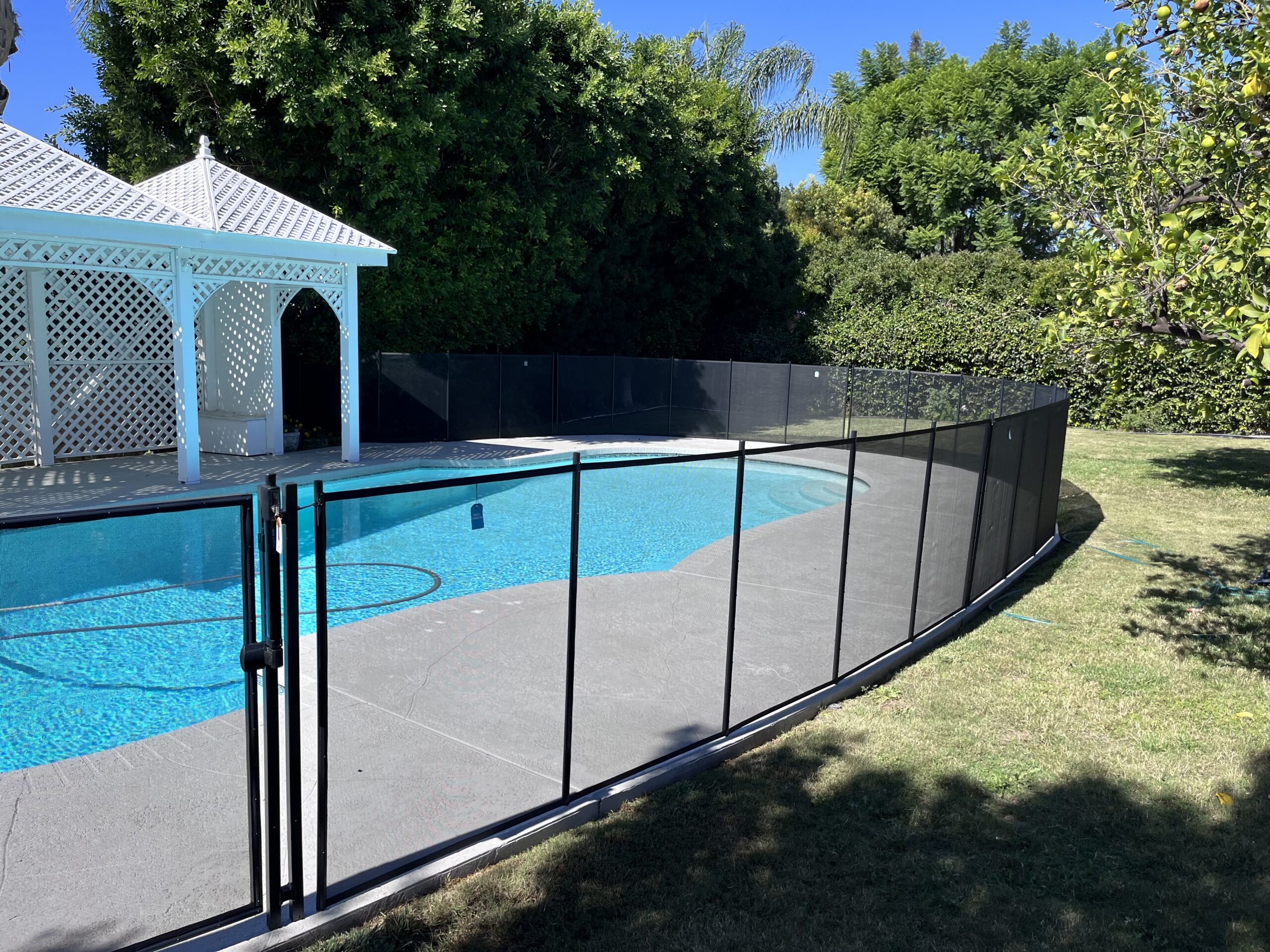
Our mesh pool fence meets every requirement under HSC §115923 and qualifies as an ASTM F2286 compliant removable barrier under HSC §115922(a)(2). It clears the 60-inch height minimum, passes the 4-inch gap test, provides no climbable surface, and paired with a self-closing, self-latching gate, functions as a fully standalone compliant barrier.
Removable pool fencing is practical across all three of San Bernardino County’s pool environments. In the Inland Empire it suits year-round family use. In the High Desert it handles temperature extremes better than materials that warp or corrode. In the mountain communities it can be removed and stored during winter months when pools are closed and the property is vacant, then reinstalled for summer season. Pool Defence installs compliant fences for swimming pools across San Bernardino County and throughout our Southern California service area.
Gate and Latch Requirements in San Bernardino County
Under HSC §115923, every access gate through a pool enclosure must:
- Open away from the pool, not toward the water
- Be self-closing, returning to a fully closed position without manual assistance
- Be self-latching, automatically latching upon closing with no user action required
Where a self-closing, self-latching device is used as a standalone barrier, the release mechanism must be placed no lower than 54 inches above the floor per HSC §115922(a)(5).
Gate hardware performance varies significantly across San Bernardino County’s climate zones. In the High Desert, summer temperatures exceed 110 degrees regularly, causing thermal expansion that can affect latch alignment. In the mountain communities, freeze-thaw cycles stress hardware differently. Inspectors in both regions pay close attention to whether gate latching mechanisms function consistently under local climate conditions, not just at the time of installation.
Removable Pool Fencing in San Bernardino County
Removable pool fencing is explicitly recognized under HSC §115922(a)(2) as a standalone compliant barrier, provided the fence meets the ASTM International F2286 performance standard and is paired with a compliant gate.
Ask any installer to provide written ASTM F2286 documentation before signing a contract. Compliance should be verifiable on paper, not just verbally claimed.
In San Bernardino County’s mountain communities, mesh pool fencing is especially practical for seasonal properties. A barrier that goes up when the family arrives for summer and comes down for winter storage meets both compliance requirements and the practical reality of owning a mountain vacation property. When it is installed, it fully satisfies pool fence laws under California state law.
Mountain Community Properties: What Big Bear and Lake Arrowhead Owners Need to Know
Big Bear Lake and Lake Arrowhead are among the most popular mountain resort destinations in Southern California, drawing visitors for both summer recreation and winter skiing. A significant proportion of properties in both communities are second homes or vacation rentals rather than primary residences.
Several things make pool compliance in the mountain communities distinct from the rest of San Bernardino County:
Seasonal vacancy: Many mountain properties sit unoccupied for extended periods. California pool fence law applies regardless of occupancy. A pool at a vacant Big Bear cabin requires a compliant barrier whether anyone is staying there or not.
Climate and hardware: Freeze-thaw cycles at elevations above 6,000 feet introduce stresses on pool barrier hardware that flat-desert and suburban properties never face. Gate posts set in ground that freezes and thaws repeatedly can shift over time, affecting height compliance and ground clearance. Annual inspection of post depth and gate alignment is advisable.
Vacation rental activity: Like the Coachella Valley in Riverside County, Big Bear Lake and Lake Arrowhead have active short-term rental markets. Pool compliance is part of the operational baseline for any STR property with a pool, and a non-compliant barrier increases liability exposure significantly in a rental context.
Properties in incorporated Big Bear Lake apply for permits through the City of Big Bear Lake Building Division. Many surrounding properties fall in unincorporated San Bernardino County territory and apply through Land Use Services.
High Desert Properties: Compliance Across a Spread-Out Region
The High Desert communities of Victorville, Hesperia, Apple Valley, and Adelanto have grown significantly over the past decade as Inland Empire housing costs pushed residents further out. The region has a higher proportion of unincorporated residential land than the Inland Empire proper, meaning more homeowners deal with the county permit track rather than a city building department.
In the High Desert, ground clearance compliance deserves particular attention. Desert soil composition and wind-driven sand movement can gradually reduce clearance between a fence post and the ground over time or create low spots along the fence line that were not present at installation. An annual check of ground clearance along the full fence perimeter is advisable in High Desert properties.
How the Permit Process Works in San Bernardino County
The general permit sequence is consistent whether you are in an incorporated city or unincorporated county territory:
- Application: City residents apply through their city’s building department. Unincorporated area residents apply through San Bernardino County Land Use Services.
- Plan check: Your barrier configuration is reviewed against HSC §115922 and §115923 and any applicable local amendments.
- Permit issued: Once approved, installation can begin.
- Inspections: A building inspector visits at key construction stages.
- Final sign-off: The completed barrier is physically inspected before the permit closes.
Mountain community and High Desert properties processed through county Land Use Services may have different timelines than Inland Empire city permits. Confirm current wait times before scheduling work.
Pool Fence Rules by City in San Bernardino County
Key building authorities across San Bernardino County:
- City of San Bernardino: Pool permits through the City of San Bernardino Community Development Department.
- Ontario: City of Ontario Building and Safety.
- Rancho Cucamonga: City of Rancho Cucamonga Building and Safety.
- Fontana: City of Fontana Building and Safety Division.
- Chino Hills: City of Chino Hills Building Division.
- Victorville: City of Victorville Building and Safety.
- Hesperia: City of Hesperia Building and Safety.
- Big Bear Lake: City of Big Bear Lake Building Division.
- Unincorporated San Bernardino County (High Desert unincorporated areas, mountain communities outside city limits, and others): San Bernardino County Land Use Services.
If your city is not listed, contact your city’s building or community development department directly to confirm current pool fence requirements and any local amendments.
Pool Fence Inspections: What San Bernardino County Inspectors Look For
A city or county building inspector physically assesses your barrier against fence requirements for a pool under HSC §115923. Standard inspection points include:
- Height: minimum 60 inches from the outside at all points, including corners and gate frames
- Ground clearance: no gap exceeding 2 inches anywhere along the fence line — particularly scrutinized in High Desert properties where sandy soil shifts over time
- Gap size: no opening allows a 4-inch sphere to pass through
- Gate self-close and self-latch: tested from multiple open positions; must close and latch without manual assistance every time
- Gate direction: must open away from the pool
- Climbability: outside surface assessed for horizontal rails, footholds, or other climbing aids
In mountain community inspections, post stability and ground clearance get additional attention given freeze-thaw ground movement.
Why Pool Fence Compliance Matters in San Bernardino County
Under HSC §115928, violations of the Swimming Pool Safety Act carry civil penalties of up to $1,000 per violation. Beyond fines, a non-compliant barrier creates significant liability exposure in the event of a drowning or near-drowning incident.
For Inland Empire homeowners, pool compliance affects property transactions. For mountain community and High Desert second-home owners, it is an ongoing responsibility at a property that may sit unattended for months. For vacation rental operators in Big Bear Lake or Lake Arrowhead, it is an operational requirement that intersects with rental licensing and commercial liability.
Getting compliant before any permit, listing, or rental activity begins is the right starting point regardless of which region of the county your property is in.
Get a Compliant Pool Fence Installed in San Bernardino County
Pool Defence installs fully compliant mesh pool fencing across San Bernardino County, from the Inland Empire to the High Desert and the mountain communities. Every installation meets the full range of pool fence standards enforced across the county’s 24 cities and unincorporated areas. View our full service area to confirm we cover your address.
Sources
- “Health and Safety Code Section 115920.” California Legislative Information, California State Legislature, leginfo.legislature.ca.gov. Accessed 18 Sep. 2026.
- “Health and Safety Code Section 115922.” California Legislative Information, California State Legislature, amended 1 Jan. 2025, leginfo.legislature.ca.gov. Accessed 18 Sep. 2026.
- “Health and Safety Code Section 115923.” California Legislative Information, California State Legislature, leginfo.legislature.ca.gov. Accessed 18 Sep. 2026.
- “Health and Safety Code Section 115928.” California Legislative Information, California State Legislature, leginfo.legislature.ca.gov. Accessed 18 Sep. 2026.
- “Land Use Services.” County of San Bernardino, www.sbcounty.gov. Accessed 18 Sep. 2026.
- “Building and Safety.” City of San Bernardino, www.sbcity.org. Accessed 18 Sep. 2026.
- “Building and Safety.” City of Ontario, www.ontarioca.gov. Accessed 18 Sep. 2026.
- “Building and Safety.” City of Rancho Cucamonga, www.cityofrc.us. Accessed 18 Sep. 2026.
- “Building and Safety Division.” City of Fontana, www.fontana.org. Accessed 18 Sep. 2026.
- “Building Division.” City of Chino Hills, www.chinohillsca.gov. Accessed 18 Sep. 2026.
- “Building and Safety.” City of Victorville, www.victorvilleca.gov. Accessed 18 Sep. 2026.
- “Building and Safety.” City of Hesperia, www.cityofhesperia.us. Accessed 18 Sep. 2026.
- “Building Division.” City of Big Bear Lake, www.citybigbearlake.com. Accessed 18 Sep. 2026.